Business operating
ScotAi has a new Substack channel - this article was published 16 October 2026. Look out for more content coming soon.
Where is AI really adding value in engineering services? Sometimes, it’s just doing the thing we all hate.
Most engineering services companies I know have “the spreadsheet”. It started as a list of calibration dates, created by someone years ago, then somebody added a tab for technicians’ tickets, then the van MOTs went on another one, and at some point someone clever added conditional formatting so the cells go red when things are about to run out. (Usually they do. Occasionally the formula’s been dragged down wrong and they don’t. Finding out is never fun.)
Whoever built it has probably moved on by now. Everyone’s a bit worried about messing with it. Everyone relies on it anyway.
Often, an ERP was brought in to hold all this. It cost a fortune - but not as much as all the consultants invoices required to tailor it. It’s the same for the maintenance system that got bought a few years ago. In practice it all lives in that spreadsheet and in the heads of two or three people. If one of them’s off sick the Monday before a big mobilisation, you’ll know about it.
That’s one place AI is really earning its keep. It’s not sexy, and it doesnt look flashy on the conference stage - but what a difference.
I’ve sat through my share of talks about digital twins and predictive maintenance. Some of it’s real, some smoke and mirrors desperate for investment. Some of it’ll get there eventually. The change I actually see day to day is a lot more boring than that: AI has got quite good at reading, organising and reminding.
It’s fundamentally important, because operations runs on paperwork. Cal certs, training tickets, inspection reports, OEM manuals, GA drawings, and that email from the cal lab that says ‘see attached’ and nothing else. They all need to be present, correct and auditable. But every bit of software the industry’s bought in the last twenty-odd years has needed someone to diligently open those documents and type the important numbers in somewhere (with no typo’s!). Nobody has time for that on a Friday afternoon, so the system goes stale, people stop believing it, and the spreadsheet quietly wins again.
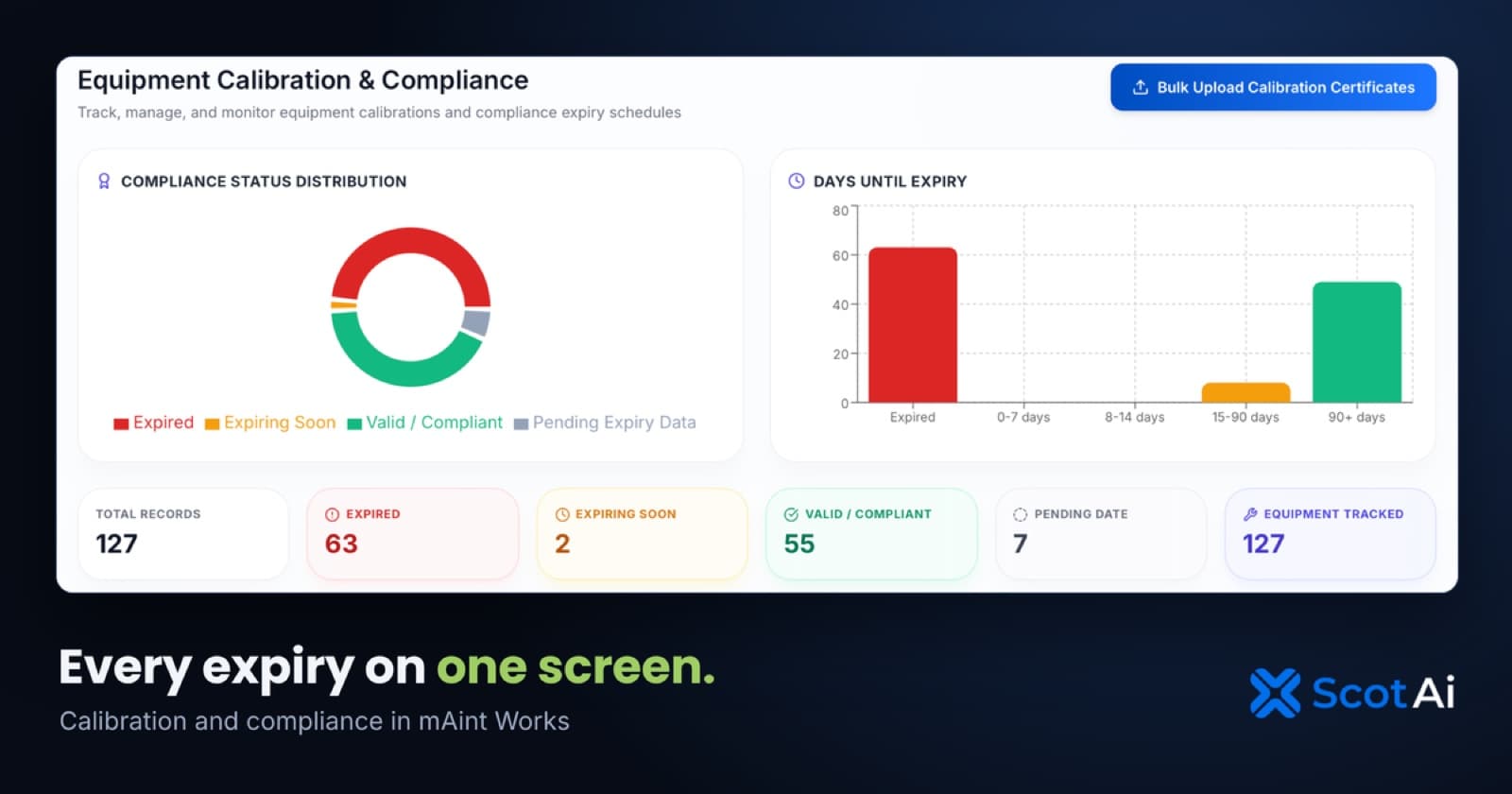
We’ve built something into mAint Works that sounds almost too simple to bother mentioning. There’s an email address you copy in when a certificate turns up, and that’s it. When the calibration lab sends through the certs for a torque tool, get them to CC mAint Works on the email. The system reads it, works out which asset it belongs to, files it and updates the dates and reminders. Same with a technician’s training tickets. It would be pretty dull for a conference presentation. Not nearly as spectacular as a digital twin. But have a think about how many certs arrive in your inboxes in a month, and how many of them make it into a system, and you’ll see why I like it.
When I mention AI to ops managers I usually hear ‘we’ve got Copilot’ or ‘we’ve got a Claude subscription’. Which is fair enough. I could politely say that Copilot’s handy for tidying an email or summarising a Teams call, and Claude’s capabilities are definetly impressive. But they sit there until you ask them something. They won’t let you know that the tech you’re planning to mobilise for a job next week has a ‘Working at Heights’ refresher due on the second day of the project.
Wind’s a good example of how quickly this gets away from you. A wind technician’s training record is a stack of GWO modules. There can be a dozen or more lines on a WINDA cert. First aid, manual handling, fire awareness, working at heights, sea survival, then the technical modules and rescue on top, depending on the job. They’ve all got their own expiry dates because nobody does them all in the same week.
So a company with just thirty techs has over three hundred dates to manage - on people alone. Most of them will be fine. It’s the one that isn’t that delays a mobilisation, and you usually find out at the worst possible moment, when somebody checks WINDA before letting them on site.
In Works, the system analyses every one of those lines separately, so the system knows a tech’s fine on everything except working at heights, which is up in six weeks. It flags it, and if you’ve loaded your approved training providers it’ll even send them the enquiry itself. If you can get the supplier to CC mAint Works on the email, that’s the record sorted - it’s updated automatically. Swap the tech for a torque wrench and the training provider for a calibration lab and it’s the same process.
Isn’t managing projects hard enough without all that stress? We’ve all heard the story of the wind turbine blades collapsing, not long after being serviced… and it turned out the torque tool was out of calibration….
It’s not that clever, it’s not that sexy. But it’s reliable. Week in, week out. It doesn’t get bored and it doesn’t go on holiday.
The reason we started ScotAi in the first place was that we wanted to help solve the shortage of technicians for the energy transition. That isn’t sorting itself out any time soon. Experienced people are retiring - especially in oil and gas. There aren’t enough coming through behind them, and the ones who are get asked to step up a lot sooner than they used to.
The next generation of technicians cant be trained quickly enough. The next best thing is to stop burning the time of the technicians you’ve already got on stuff that isn’t engineering. Report writing’s the big one. In the mAint Inspect module, we’ve improved quality AND saved up to four hours report writing for each site visit. It’s half a day back for somebody you’d struggle to replace, and less re-writing time for the management team too.
Bear in mind that it’s not all roses. The first time you dump your excel document into mAint Works, prepare to be a wee bit embarrassed. There’s often a pile of lapsed certs, and that red column on the dashboard will grate at you until you find and fix them (it’s actually quite satisfying to see it turn green - but maybe that’s just me). There’s usually a few bits of kit nobody can find too. Better you find that than a client auditor, or a project manager preparing a mob…. At least, if you click on the ‘planned inventory’ tab in mAint Works, stock checks are a mobile-friendly doddle.
So, if you’re planning to ‘AI’ your engineering services, bear in mind that super-flashy might not be the way forward. What really matters is whether it takes boring paperwork off the people on the tools or puts more work on them.
And somebody still signs it off. The AI can read the cert, spot the expiry and draft the enquiry, but a competent person still decides whether a tech goes to site or a tool goes in the van. I can’t see that changing, and I don’t think it should.
So, back to the spreadsheet.
I don’t think the service companies that do well over the next few years will be the ones with the cleverest AI. I reckon it’ll be the ones who can say yes to work quickly. When we built ROVOP (the ROV services business), we did it partly by being able to mobilise faster than our competitors. A couple of times we even managed to mobilise the ROV system onto the vessel before our competitors had submitted their proposal - ouch!). For services companies, this has an amazing impact on growth. You get to be seen as ‘the cavalry’ coming in to save the day - which means that next time the frame agreement is due for renewal, you might well be included in their list of vendors.
If you want to mobilising quickly and efficiently, everything has to be in order. It’s complex. People can let you down - but AI will just work and work and work. It helps the PM mob the right people, tickets in date, kit calibrated, van taxed and insured, with the right spares, on site when the client wants them. Frame agreements get won and kept on exactly that.
One of our customers recently won a a huge valve management contract. They had recently set up the valve division and tendered to the NOC. They didn’t think they had a chance - but they had nothing to lose either. After showcasing in their tender how they run their equipment and inventory on the mAint Works platform, they won based on their (ie our!) innovation, which I was pretty chuffed about.
Nobody got into engineering to chase certificates. If AI takes the chasing off people and leaves them to get on with the engineering, that’ll do me.
Oh - and those expensive ERP consultants? With mAint, there are none. We work direct with our clients to optimise the system for them - at no extra cost.
And if you’ve got a spreadsheet you’d like to see the back of, give me a shout.