Business operating
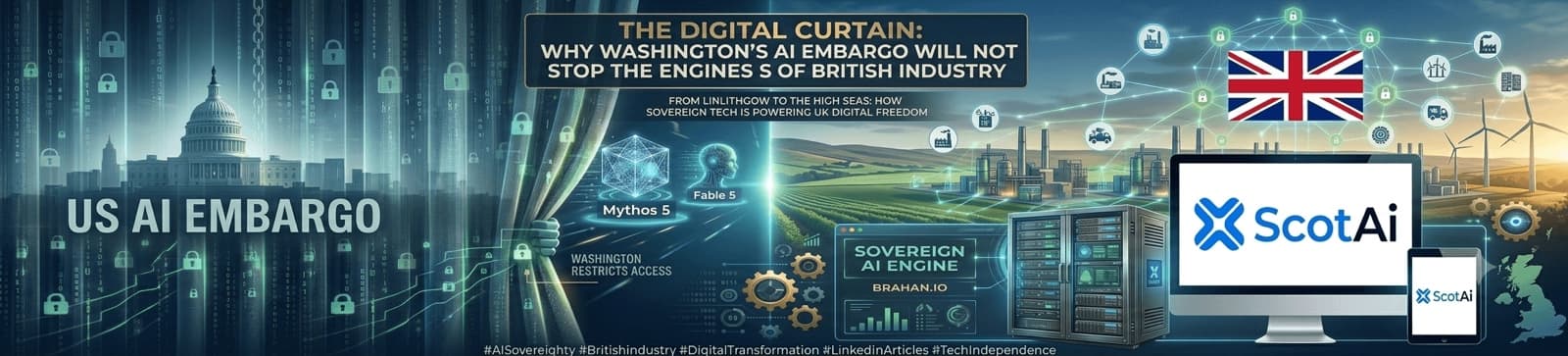
The digital Atlantic just grew significantly, dangerously wider.
When Anthropic abruptly pulled the plug on its highly anticipated Mythos 5 and Fable 5 AI models for all non-US users, it was not an act of corporate caprice. It was the blunt enforcement of a Washington directive restricting next-generation artificial intelligence to American soil. For European governments and enterprises that had pegged their digital transformation strategies to American tech infrastructure, the cracks in that decision have begun to show.
The immediate fallout and long term implications are severe. Once again, Europe is left stranded on the wrong side of a protectionist fence, exposed by its profound reliance on Silicon Valley.
Yet, history suggests that when access is denied, necessity dictates engineering. Where Washington builds walls, a quiet, two-year-old software business in Linlithgow is showing that Scotland might just have the keys to UK digital sovereignty.
The Vision of the Seer
Responding to the embargo, Edinburgh-based ScotAI has formally broken cover with the wide release of Brahan.IO. Named after Coinneach Odhar, the 17th-century Brahan Seer who famously predicted the Caledonian Canal and the Aberdeen oil industry, the platform is designed for a very modern kind of foresight: navigating complex datasets when the global supply chain for technology fractures.
While Silicon Valley behemoths burn billions chasing ever-larger, generalised models to write poetry or create consumers' playthings, ScotAI has spent its short two years quietly embedding itself in the unglamorous, critical infrastructure of the real economy.
Brahan.IO isn't built to amuse consumers. It is a UK-sovereign technology platform designed specifically to integrate and analyse massive, complex datasets for high-stakes government and commercial decision-making.
Its credentials are already decoupling it from the broader AI hype cycle. The underlying engine has been independently assessed by the UK Ministry of Defence and defence engineering giant Raytheon, earning the distinction of being rated as the most accurate, secure, and reliable AI on the planet.
"We cannot depend on the shifting political winds of Washington to accelerate performance in our critical sectors," says Nick Thomas, Chief Technology Officer at ScotAI. "Serious industry requires sovereign technology, and that can mean a few different things to many different people, but to me it means that we need to own our own ability to execute work."
Accuracy in Chaotic Data
The platform's core architecture highlights a fundamental truth often ignored in the AI gold rush: output is only as good as input. In heavy industry, human error in data management causes operational chaos.
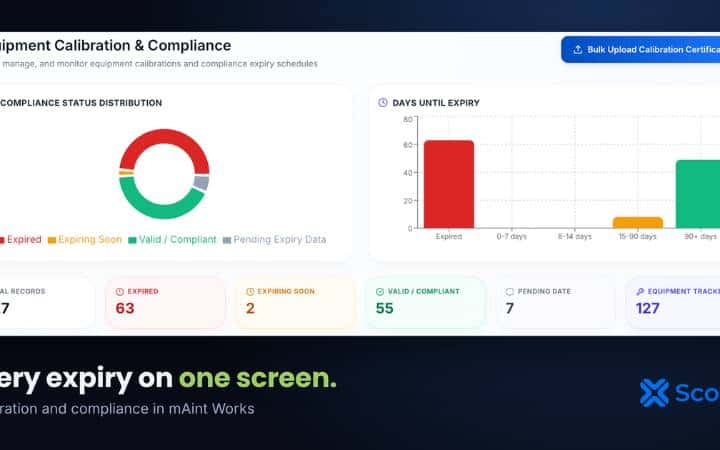
Operating as the engine behind ScotAI’s mAint platform, Brahan operates on an entirely different philosophy than its American counterparts:
• Sovereignty and Security: User data is heavily encrypted and kept strictly local. Crucially, client data is never used to train public models unless explicitly requested.
• Scale and Flexibility: The on-premise system can ingest up to 1 million files simultaneously, while the cloud-native iteration connects directly to secure enterprise environments like SharePoint.
• Deep Extraction: Instead of relying on US-controlled models, Brahan utilises a curated selection of highly efficient information-extraction models, many designed entirely in-house.
• Multimodal Rigour: It bypasses consumer "fun features" to focus ruthlessly on what engineers actually need: extracting data from thousands of structured and unstructured files, including graphs, charts, and text embedded deep within heavily degraded, scanned engineering drawings.
By deploying these specialised modules to audit client data, mAint maps massive datasets to highlight technical inconsistencies before they manifest in steel and concrete.
From Turbine Blades to the Energy Transition
The theoretical power of sovereign AI is one thing; its application in Scotland’s industrial heartlands is another.
Take aerospace. There are few environments more critical than the inspection and repair of the gas turbines powering military and civilian jets. In Dundee, ATL Turbine Services has just been recognised at the 2026 Scottish Engineering Awards, picking up the prestigious Business Transformation Award. A cornerstone of that overhaul was the deployment of mAint.
"mAint by ScotAI is strengthening our consistency, traceability, and quality of our turbine component inspection and repair process," notes Wayne Thomson, ATL’s Operations Director. "The platform is genuinely impressive, and the team has been highly responsive to our operational needs."
The impact is echoing north to Aberdeen. Speaking on 17 June 2026 at the University of Aberdeen’s prestigious Watt Hepburn lecture, Doug Duguid, CEO of the £125-million engineering services giant Aurora Energy Services, singled out ScotAI’s work as a fundamental differentiator for competitive advantage in a rapidly evolving market.
Aurora, which employs 1,000 staff and is growing at an impressive 35% annually, has been running live trials with the system to optimise maintenance schedules with original equipment manufacturers (OEMs), establish competency standards, and radically accelerate the commercial bid process for contract renewals.
"Technology is changing the world," Duguid told the audience. "We have been running trials with ScotAi to optimise maintenance and test competency standards, and are trialling it for contract renewals, to speed up the bid process. We have a project on just now, to look at our Project Management processes, to create dashboards to take data and create better management information to keep clients better informed. I think all of those things will be differentiators. While there are threats as to what AI might do, there are huge opportunities as to how we improve efficiency."
The Editorial Verdict
Washington’s protectionist pivot on AI models like Mythos and Fable was intended to secure an American monopoly on the future. Instead, it may well backfire by exposing the vulnerability of European dependence and forcing allied nations to build their own fortresses.
By denying international access, the US government has inadvertently accelerated the rise of localised, fiercely secure, and industrially focused tech ecosystems.
The original Brahan Seer met a fiery end in a barrel of burning tar on the Black Isle. His modern, digital namesake, however, aims to ignite a long-overdue bonfire of European tech dependency. For serious businesses in engineering, energy, and defence, the oracle is online - and it was built at home.